Five months or so ago, I announced here that I was going to sign up for the Rump Roast 5K run on September 26th in Minocqua. I had put doing a 5K on my "life list," and I figured that by starting to get in shape in April I'd be able to handle the run 5 months later.
Well, I chickened out. Instead of running on Saturday, my rump will be roosting in Miller Park at the Brewer game. I'll most likely have an overpriced brat in one hand and a beer in the other. I'm going to Milwaukee for the weekend with my bowling team--and of course, one of the first items we decided was who would bring what snacks.
I don't know what it would take to keep me on the straight and narrow where food is concerned. Maybe I need to throw out all my cookbooks and cooking magazines, my cookie sheets and cake pans. Have some skinny, health-conscious person do my grocery shopping. Watch The Biggest Loser instead of Dancing With the Stars. Hear a bratty little kid call me Fatty fatty two-by-four.
Seriously, I know what I have to do; I just can't seem to get it done. Life = socializing = food = temptation. Living in a cave and having someone deliver me lettuce and water might work.
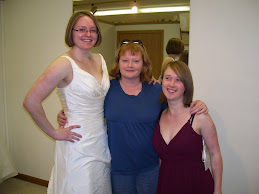
Less than nine months to Erica and Craig's wedding, and I'm no closer to looking for a mother-of-the-bride dress than I was six months ago. I can visualize the thought bubbles over people's heads as I come down the aisle:
"The mother of the bride is looking wide!" "She used to be thinner; what's she eating for dinner?!" "Her hair's natural red, but she's been overfed." "Wonder what she spent to buy that tent?" "After the wedding she can use it for bedding."
Just kidding--everyone will have their eyes on Erica anyway. Besides, I'm really not that desperate yet.
Maybe that's the problem.
**Happy birthday to Fred tomorrow!! I love you!!
Thursday, September 24, 2009

Wednesday, September 23, 2009
I'm in a Hurry and Don't Know Why...
Since my late 20s, I guess after having kids, I have always felt like I'm in a hurry. There aren't enough hours in a day, and I rush from one activity to another--wanting the first to be done with so I can get to the next. I am impatient over anything that takes "too much time"--the computer not loading fast enough, the old guy driving 10 mph ahead of me, being put on hold by customer service like I don't have anything better to do. I've learned repeatedly that haste really does make waste, but it still hasn't sunk in. Just now I put laundry in the washing machine, and as I hurriedly grabbed the detergent off the shelf, I knocked the bottle of Shout down and broke the sprayer. Now I'm impatient and mad. It reminds me of an episode of All in the Family when hostility-plagued Archie Bunker read aloud an article title from The Reader's Digest: "Your Personality May Be Killing You."
The experts call this problem Time Urgency (TU) or Time Urgency and Impatience (TUI). It is typical of people with Type A personalities, but others can be affected, too. In an article by Dr. R. Murali Krishna, these questions are posed to determine if you may suffer from TU:
"Do you dislike waiting or feel impatient with the rate at which many things take place?
Do you find it difficult to linger at the table after eating?
Do you regularly do more than one thing at a time?
Do you suffer from "racing mind" and experience disturbances in your sleep?
Do you feel a chronic sense of time pressure?
Have you lost interest in activities away from your job?
Do you measure yourself by quantitative accomplishments?
Do you have difficulty accumulating pleasant memories?
Do you have a deep-seated need to be on time, or conversely, are you always late?
If you answered yes to any of these, you may have time urgency. It's not a healthy condition to have."
I'm not sure why I still feel this urgency at this stage of my life. My kids are grown up and I'm not working. A former expert at multi-tasking, I still try to do it--and now invariably end up with 3 or more failed efforts that have to be fixed or begun again.
Dr. Krishna offers ways to overcome TU in the complete article, which can be found at http://www.integris-health.com/INTEGRIS/en-US/Specialties/MindBodySpirit/Newsroom/MindMatters/TimeUrgency.htm
In the meantime, I will try to use some of his suggestions for slowing down. I already have enough strikes against me for developing heart disease. And, dear Fred, you should take a good look at this, too.
The experts call this problem Time Urgency (TU) or Time Urgency and Impatience (TUI). It is typical of people with Type A personalities, but others can be affected, too. In an article by Dr. R. Murali Krishna, these questions are posed to determine if you may suffer from TU:
"Do you dislike waiting or feel impatient with the rate at which many things take place?
Do you find it difficult to linger at the table after eating?
Do you regularly do more than one thing at a time?
Do you suffer from "racing mind" and experience disturbances in your sleep?
Do you feel a chronic sense of time pressure?
Have you lost interest in activities away from your job?
Do you measure yourself by quantitative accomplishments?
Do you have difficulty accumulating pleasant memories?
Do you have a deep-seated need to be on time, or conversely, are you always late?
If you answered yes to any of these, you may have time urgency. It's not a healthy condition to have."
I'm not sure why I still feel this urgency at this stage of my life. My kids are grown up and I'm not working. A former expert at multi-tasking, I still try to do it--and now invariably end up with 3 or more failed efforts that have to be fixed or begun again.
Dr. Krishna offers ways to overcome TU in the complete article, which can be found at http://www.integris-health.com/INTEGRIS/en-US/Specialties/MindBodySpirit/Newsroom/MindMatters/TimeUrgency.htm
In the meantime, I will try to use some of his suggestions for slowing down. I already have enough strikes against me for developing heart disease. And, dear Fred, you should take a good look at this, too.
Tuesday, September 22, 2009
Shield That Noggin!
Over the weekend, the 27th annual Fall Ride motorcycle rally was held in Tomahawk. Organizers were expecting 30 to 40 thousand bikes to be in attendance, and Fred and I would have gone if we hadn't had other plans.
On my way to Elk Mound Friday and again on the way back here Sunday, I saw hundreds of bikes on highways 51 and 29, making the trip to and from the rally. I started noticing how few of the bikers were wearing helmets. Long hair streaming, some with do-rags, men and women alike; I'd estimate 75% or more had forgone protective headgear in favor of riding wild and free.
Fred and I always wear helmets when we ride. I don't have any statistics, but even with a helmet, I'm not optimistic about avoiding serious injury or worse in an accident. However, the helmet is the one thing giving me hope that we would; without one, I picture a rider's head splitting open on the road like an overripe melon.
I know why people don't like to wear them. They can be hot, and mine makes my head itch. It's a bother taking it off/putting it back on every time you stop. The face shield made me claustrophobic, so I took that off almost immediately. Feeling the wind blow through your hair can be liberating--but then, having your head in one piece can be too.
When I read the newspapers or hear on the news that someone has been killed on a motorcycle, the story usually adds a postscript: "The victim was--or was not--wearing a helmet." More often than not, he or she wasn't.
I'm born to be wild, but I also value my round head and the brain cells I have left. So even if I look dorky, you'll always see me in my bright red helmet when I'm on the bike--whether it's a short ride or a long one.
Be safe out there!
On my way to Elk Mound Friday and again on the way back here Sunday, I saw hundreds of bikes on highways 51 and 29, making the trip to and from the rally. I started noticing how few of the bikers were wearing helmets. Long hair streaming, some with do-rags, men and women alike; I'd estimate 75% or more had forgone protective headgear in favor of riding wild and free.
Fred and I always wear helmets when we ride. I don't have any statistics, but even with a helmet, I'm not optimistic about avoiding serious injury or worse in an accident. However, the helmet is the one thing giving me hope that we would; without one, I picture a rider's head splitting open on the road like an overripe melon.
I know why people don't like to wear them. They can be hot, and mine makes my head itch. It's a bother taking it off/putting it back on every time you stop. The face shield made me claustrophobic, so I took that off almost immediately. Feeling the wind blow through your hair can be liberating--but then, having your head in one piece can be too.
When I read the newspapers or hear on the news that someone has been killed on a motorcycle, the story usually adds a postscript: "The victim was--or was not--wearing a helmet." More often than not, he or she wasn't.
I'm born to be wild, but I also value my round head and the brain cells I have left. So even if I look dorky, you'll always see me in my bright red helmet when I'm on the bike--whether it's a short ride or a long one.
Be safe out there!
Monday, September 21, 2009
Waiting for Someone
Trying to sell a house in today's market is a frustrating experience. Our home in Elk Mound has been for sale almost two and a half years now. We've had three realtors and accepted two offers--both of which fell through. I've cleaned the place about 50 times for showings and open houses, and went over there every two or three weeks this summer to mow the lawn. We've had the carpets cleaned, painted inside, and put in a $10,000 mound septic system a week after we moved to Rhinelander. We've steadily lowered the price, but it still hasn't sold.
Friday I drove over again to clean and do yardwork for a showing Saturday and an open house yesterday. Friday I cleaned the gutters on the house, picked three big containers of apples from the tree in the back yard, and packed up the stuff Katie had left there after moving back to Eau Claire for school. Saturday I was up at 7, scouring sinks and showers, mopping floors, vacuuming, knocking down cobwebs, dusting, and sweeping. Then it was outside to mow the lawn, clear branches from a downed tree, and clean up the dog kennel.
Around noon I sat on the deck to eat some yogurt and cool off. I looked around the back yard beneath its canopy of trees as acorns bounced on the deck around me. Down the valley, the trees were just starting to change color, and I heard the clang of the pumpkin launcher at the tree farm as they opened the new season.
As the breeze blew over me, I had an epiphany. I realized that this property isn't going to be purchased by people trying to get it as cheaply as they can or who complain that it needs work. It will be bought by someone who loves the home on the hill, nestled in a clearing surrounded by trees. Someone who wants to see birds and deer and even a bear or two in their back yard. Someone who will feed the stray cats, tame them, and let them come inside on frigid winter nights. Someone who won't mind walking more than a half mile down to the mailbox or parking their car at the neighbor's when it's too icy to make it up the hill. Someone who wants to raise kids and puppies and chickens and maybe even a cow in a peaceful and beautiful setting. Someone who will tell her husband what I told Fred 13 years ago the first time I went there: "This is the place I want. Can we get it?" "Well," he said, "the furnace is going to need replacing soon, and it's more than we were planning to spend..." "Please??"
I know that "someone" is out there. And that's who I want to have our house.
Friday I drove over again to clean and do yardwork for a showing Saturday and an open house yesterday. Friday I cleaned the gutters on the house, picked three big containers of apples from the tree in the back yard, and packed up the stuff Katie had left there after moving back to Eau Claire for school. Saturday I was up at 7, scouring sinks and showers, mopping floors, vacuuming, knocking down cobwebs, dusting, and sweeping. Then it was outside to mow the lawn, clear branches from a downed tree, and clean up the dog kennel.
Around noon I sat on the deck to eat some yogurt and cool off. I looked around the back yard beneath its canopy of trees as acorns bounced on the deck around me. Down the valley, the trees were just starting to change color, and I heard the clang of the pumpkin launcher at the tree farm as they opened the new season.
As the breeze blew over me, I had an epiphany. I realized that this property isn't going to be purchased by people trying to get it as cheaply as they can or who complain that it needs work. It will be bought by someone who loves the home on the hill, nestled in a clearing surrounded by trees. Someone who wants to see birds and deer and even a bear or two in their back yard. Someone who will feed the stray cats, tame them, and let them come inside on frigid winter nights. Someone who won't mind walking more than a half mile down to the mailbox or parking their car at the neighbor's when it's too icy to make it up the hill. Someone who wants to raise kids and puppies and chickens and maybe even a cow in a peaceful and beautiful setting. Someone who will tell her husband what I told Fred 13 years ago the first time I went there: "This is the place I want. Can we get it?" "Well," he said, "the furnace is going to need replacing soon, and it's more than we were planning to spend..." "Please??"
I know that "someone" is out there. And that's who I want to have our house.
Friday, September 18, 2009
Scooped!
Today's topic was going to be the increasing lack of civility in our society as evidenced by recent behavior of some celebrities, athletes, and politicians. But--last night on "Primetime Saturday Night Live," my whole blog's content was pretty much covered in one of their skits!! So as not to appear a plagiarist, I am cancelling today's entry.
I'm off to Eau Claire for a birthday lunch and to get the Elk Mound house ready for another open house on Sunday. Have a great weekend, everybody!!
I'm off to Eau Claire for a birthday lunch and to get the Elk Mound house ready for another open house on Sunday. Have a great weekend, everybody!!
Thursday, September 17, 2009
The Endangered List
A few days ago a friend sent me a forward called "Things About to Become Extinct in America." I thought it was interesting reading and decided to be a lazy blog writer today and share it here. The disappearance of the honey bees and the family farm should concern all of us. Personally, I am bothered by the demise of the handwritten letter, but I doubt that will cause the end of the world. Last night I saw an ad for the Sony digital reader--and now I'm worried that books might soon be on this list. I won't enjoy curling up with a blanket on a rainy day to use my digital reader!! I want a real book that I can touch, write notes in the margin, pass on to a friend. There are some places technology should keep its nose out of...in my humble opinion.
THINGS ABOUT TO BECOME EXTINCT IN AMERICA
25. U.S. Post Office: They are pricing themselves out of existence. With e-mail, and online services they are a relic of the past. (refer to #9) Packages are also sent faster and cheaper with UPS.
24. Yellow Pages: This year will be pivotal for the global Yellow Pages industry Much like newspapers, print Yellow Pages will continue to bleed dollars to their various digital counterparts, from Internet Yellow Pages (IYPs), to local search engines and combination search/listing services like Reach Local and Yodel Factors like 20 an acceleration of the print 'fade rate' and the looming recession will contribute to the onslaught. One research firm predicts the falloff in usage of newspapers and print Yellow Pages could even reach 10% this year -- much higher than the 2%-3% fade rate seen in past years.
23. Classified Ads: The Internet has made so many things obsolete that newspaper classified ads might sound like just another trivial item on a long list. But this is one of those harbingers of the future that could signal the end of civilization as we know it. The argument is that if newspaper classifieds are replaced by free online listings at sites like Craigslist.org and Google Base, then newspapers are not far behind them.
22. Movie Rental Stores: While Netflix is looking up at the moment, Blockbuster keeps closing store locations by the hundreds. It still has about 6,000 left across the world, but those keep dwindling and the stock is down considerably in 2008, especially since the company gave up a quest of Circuit City . Movie Gallery, which owned the Hollywood Video brand, closed up shop earlier this year. Countless small video chains and mom-and-pop stores have given up the ghost already.
21. Dial-up Internet Access: Dial-up connections have fallen from 40% in 2001 to 10% in 2008. The combination of an infrastructure to accommodate affordable high speed Internet connections and the disappearing home phone have all but pounded the final nail in the coffin of dial-up Internet access.
20. Phone Land Lines: According to a survey from the National Center for Health Statistics, at the end of 2007, nearly one in six homes was cell-only and, of those homes that had land lines, one in eight only received calls on their cells.
19. Chesapeake Bay Blue Crabs: Maryland 's icon, the blue crab, has been fading away in Chesapeake Bay . Last year Maryland saw the lowest harvest (22 million pounds) since 1945. Just four decades ago the bay produced 96 million pounds. The population is down 70% since 1990, when they first did a formal count. There are only about 120 million crabs in the bay and they think they need 200 million for a sustainable population. Over-fishing, pollution, invasive species and global warming get the blame.
18. VCRs: For the better part of three decades, the VCR was a best-seller and staple in every American household until being completely decimated by the DVD, and now the Digital Video Recorder (DVR). In fact, the only remnants of the VHS age at your local Wal-Mart or Radio Shack are blank VHS tapes these days. Pre-recorded VHS tapes are largely gone and VHS decks are practically nowhere to be found. They served us so well.
17. Ash Trees: In the late 1990's, a pretty, iridescent green species of beetle, now known as the emerald ash borer, hitched a ride to North America with ash wood products imported from eastern Asia . In less than a decade, its larvae have killed millions of trees in the
Midwest , and continue to spread. They've killed more than 30 million ash trees in southeastern Michigan alone, with tens of millions more lost in Ohio and Indiana .. More than 7.5 billion ash trees=2 0are currently at risk.
16. Ham Radio: Amateur radio operators enjoy personal (and often worldwide) wireless communications with each other and are able to support their communities with emergency and disaster communications if necessary, while increasing their personal knowledge of electronics and radio theory. However, proliferation of the Internet and its popularity among youth has caused the decline of amateur radio. In the past five years alone, the number of people holding active ham radio licenses has dropped by 50,000, even though Morse Code is no longer a requirement.
15. The Swimming Hole: Thanks to our litigious society, swimming holes are becoming a thing of the past. '20/20' reports that swimming hole owners, like Robert Every in High Falls, NY, are shutting them down out of worry that if someone gets hurt they'll sue.. And that's exactly what happened in Seattle The city of Bellingham was sued by Katie Hofstetter who was paralyzed in a fall at a popular swimming hole in Whatcom Falls Park .. As injuries occur and lawsuits follow, expect more swimming holes to post 'Keep out!' signs.
14. Answering Machines: The increasing disappearance of answering machines is directly tied to No 20 our list -- the decline of landlines. According to USA Today, the number of homes that only use cell phones jumped 159% between 2004 and 2007. It has been particularly bad in New York ; since 2000, land line usage has dropped 55%. It's logical that as cell phones rise, many of them replacing traditional landlines, that there will be fewer answering machines.
13. Cameras That Use Film: It doesn't require a statistician to prove the rapid disappearance of the film camera in America Just look to companies like Nikon, the professional' s choice for quality camera equipment. In 2006, it announced that it would stop making film cameras, pointing to the shrinking market -- only 3% of i ts sales in 2005, compared to 75% of sales from digital cameras and equipment.
12. Incandescent Bulbs: Before a few years ago, the standard 60-watt (or, yikes, 100-watt) bulb was the mainstay of every U.S. home. With the green movement and all-things-sustaina ble-energy crowd, the Compact Fluorescent Lightbulb (CFL) is largely replacing the older, Edison-era incandescent bulb. The EPA reports that 2007 sales for Energy Star CFLs nearly doubled from 2006, and these sales accounted for approximately 20 percent of the U.S. light bulb market. And according to USA Today, a new energy bill plans to phase out incandescent bulbs in the next four to 12 years.
11. Stand-Alone Bowling Alleys: Bowling Balls. US claims there are still 60 million Americans who bowl at least once a year, but many are not bowling in stand-alone bowling alleys. Today most new bo wling alleys are part of facilities for all types or recreation including laser tag, go-karts, bumper cars, video game arcades, climbing walls and glow miniature golf.
Bowling lanes also have been added to many non-traditional venues such as adult communities, hotels and resorts, and gambling casinos.
10. The Milkman: According to the U.S. Department of Agriculture, in 1950, over half of the milk delivered was to the home in quart bottles, by 1963, it was about a third and by 2001, it represented only 0.4% percent. Nowadays most milk is sold through supermarkets in gallon jugs. The steady decline in home-delivered milk is blamed, of course, on the rise of the supermarket, better home refrigeration and longer-lasting milk. Although some milkmen still make the rounds in pockets of the U.S. , they are certainly a dying breed..
9. Hand-Written Letters: In 2006, the Radicati Group estimated that, worldwide, 183 billion e-mails were sent each day.. Two million each second. By November of 2007, an estimated 3.3 billion Earthlings owned cell phones, and 80% of the world's population had access to ce ll phone coverage. In 2004, half-a-trillion text messages were sent, and the number has no doubt increased exponentially since then. So where amongst this gorge of gabble is there room for the elegant, polite hand-written letter?
8. Wild Horses: It is estimated that 100 years ago, as many as two million horses were roaming free within the United States . In 2001, National Geographic News estimated that the wild horse population has decreased to about 50,000 head. Currently, the National Wild Horse and Burro Advisory board states that there are 32,000 free roaming horses in ten Western states, with half of them residing in Nevada . The Bureau of Land Management is seeking to reduce the total number of free range horses to 27,000, possibly by selective euthanasia.
7. Personal Checks: According to an American Bankers Assoc. report, a net 23% of consumers plan to decrease their use of checks over the next two years, while a net 14% plan to increase their use of PIN debit. Bill payment remains the last stronghold of paper-based payments -- for the time being. Checks continue to be the most commonly used bill payment method, with 71% of consumers paying at least one recurring bill per month by writing a check. However, a bill-by-bill basis, checks account for only 49% of consumers' recurring bill payments (down from 72% in 2001 and 60% in 2003)..
6.. Drive-in Theaters: During the peak in 1958, there were more than 4,000 drive-in theaters in this country, but in 2007 only 405 drive-ins were still operating. Exactly zero new drive-ins have been built since 2005. Only one reopened in 2005 and five reop ened in 2006, so there isn't much of a movement toward reviving the closed ones.
5.. Mumps & Measles: Despite what's been in the news lately, the measles and mumps actually, truly are disappearing from the United States .. In 1964, 212,000 cases of mumps wer e reported in the U.S. By 1983, this figure had dropped to 3,000, thanks to a vigorous
vaccination program. Prior to the introduction of the measles vaccine, approximately half a million cases of measles were reported in the U.S. annually, resulting in 450 deaths. In 2005, only 66 cases were recorded.
4. Honey Bees: Perhaps nothing on our list of disappearing America is so dire; plummeting so enormously; and so necessary to the survival of our food supply as the honey bee. Very scary. 'Colony Collapse Disorder,' or CCD, has spread throughout the U.S. and Europe over the past few years, wiping out 50% to 90% of the colonies of many
beekeepers -- and along with it, their livelihood.
3. News Magazines and TV News: While the TV evening newscasts haven't gone anywhere over the last several decades, their audiences have. In 1984, in a story about the diminishing returns of the evening news, the New York Times reported that all three network evening-news programs combined had only 40.9 million viewers. Fast forward to 2008, and what they have today is half that.
2... Analog TV: According to the Consumer Electronics Association, 85% of homes in the U.S. get their television programming through cable or satellite providers. For the remaining 15% -- or 13 million individuals -- who are using rabbit ears or a large outdoor antenna to get their local stations, change is in the air. If you are one of these people you'll need to get a new TV or a converter box in order to get the new stations which will only be broadcast in digital..
1. The Family Farm: Since the 1930's, the number of family farms has been declining rapidly. According to the USDA, 5.3 million farms dotted the nation in 1950, but this number had declined to 2.1 million by the 2003 farm census (data from the 2007 census is just now being published). Ninety-one percent of the U.S. FARMS are small Family Farms.
Stay tuned tomorrow for "The Extinction of Civility."
THINGS ABOUT TO BECOME EXTINCT IN AMERICA
25. U.S. Post Office: They are pricing themselves out of existence. With e-mail, and online services they are a relic of the past. (refer to #9) Packages are also sent faster and cheaper with UPS.
24. Yellow Pages: This year will be pivotal for the global Yellow Pages industry Much like newspapers, print Yellow Pages will continue to bleed dollars to their various digital counterparts, from Internet Yellow Pages (IYPs), to local search engines and combination search/listing services like Reach Local and Yodel Factors like 20 an acceleration of the print 'fade rate' and the looming recession will contribute to the onslaught. One research firm predicts the falloff in usage of newspapers and print Yellow Pages could even reach 10% this year -- much higher than the 2%-3% fade rate seen in past years.
23. Classified Ads: The Internet has made so many things obsolete that newspaper classified ads might sound like just another trivial item on a long list. But this is one of those harbingers of the future that could signal the end of civilization as we know it. The argument is that if newspaper classifieds are replaced by free online listings at sites like Craigslist.org and Google Base, then newspapers are not far behind them.
22. Movie Rental Stores: While Netflix is looking up at the moment, Blockbuster keeps closing store locations by the hundreds. It still has about 6,000 left across the world, but those keep dwindling and the stock is down considerably in 2008, especially since the company gave up a quest of Circuit City . Movie Gallery, which owned the Hollywood Video brand, closed up shop earlier this year. Countless small video chains and mom-and-pop stores have given up the ghost already.
21. Dial-up Internet Access: Dial-up connections have fallen from 40% in 2001 to 10% in 2008. The combination of an infrastructure to accommodate affordable high speed Internet connections and the disappearing home phone have all but pounded the final nail in the coffin of dial-up Internet access.
20. Phone Land Lines: According to a survey from the National Center for Health Statistics, at the end of 2007, nearly one in six homes was cell-only and, of those homes that had land lines, one in eight only received calls on their cells.
19. Chesapeake Bay Blue Crabs: Maryland 's icon, the blue crab, has been fading away in Chesapeake Bay . Last year Maryland saw the lowest harvest (22 million pounds) since 1945. Just four decades ago the bay produced 96 million pounds. The population is down 70% since 1990, when they first did a formal count. There are only about 120 million crabs in the bay and they think they need 200 million for a sustainable population. Over-fishing, pollution, invasive species and global warming get the blame.
18. VCRs: For the better part of three decades, the VCR was a best-seller and staple in every American household until being completely decimated by the DVD, and now the Digital Video Recorder (DVR). In fact, the only remnants of the VHS age at your local Wal-Mart or Radio Shack are blank VHS tapes these days. Pre-recorded VHS tapes are largely gone and VHS decks are practically nowhere to be found. They served us so well.
17. Ash Trees: In the late 1990's, a pretty, iridescent green species of beetle, now known as the emerald ash borer, hitched a ride to North America with ash wood products imported from eastern Asia . In less than a decade, its larvae have killed millions of trees in the
Midwest , and continue to spread. They've killed more than 30 million ash trees in southeastern Michigan alone, with tens of millions more lost in Ohio and Indiana .. More than 7.5 billion ash trees=2 0are currently at risk.
16. Ham Radio: Amateur radio operators enjoy personal (and often worldwide) wireless communications with each other and are able to support their communities with emergency and disaster communications if necessary, while increasing their personal knowledge of electronics and radio theory. However, proliferation of the Internet and its popularity among youth has caused the decline of amateur radio. In the past five years alone, the number of people holding active ham radio licenses has dropped by 50,000, even though Morse Code is no longer a requirement.
15. The Swimming Hole: Thanks to our litigious society, swimming holes are becoming a thing of the past. '20/20' reports that swimming hole owners, like Robert Every in High Falls, NY, are shutting them down out of worry that if someone gets hurt they'll sue.. And that's exactly what happened in Seattle The city of Bellingham was sued by Katie Hofstetter who was paralyzed in a fall at a popular swimming hole in Whatcom Falls Park .. As injuries occur and lawsuits follow, expect more swimming holes to post 'Keep out!' signs.
14. Answering Machines: The increasing disappearance of answering machines is directly tied to No 20 our list -- the decline of landlines. According to USA Today, the number of homes that only use cell phones jumped 159% between 2004 and 2007. It has been particularly bad in New York ; since 2000, land line usage has dropped 55%. It's logical that as cell phones rise, many of them replacing traditional landlines, that there will be fewer answering machines.
13. Cameras That Use Film: It doesn't require a statistician to prove the rapid disappearance of the film camera in America Just look to companies like Nikon, the professional' s choice for quality camera equipment. In 2006, it announced that it would stop making film cameras, pointing to the shrinking market -- only 3% of i ts sales in 2005, compared to 75% of sales from digital cameras and equipment.
12. Incandescent Bulbs: Before a few years ago, the standard 60-watt (or, yikes, 100-watt) bulb was the mainstay of every U.S. home. With the green movement and all-things-sustaina ble-energy crowd, the Compact Fluorescent Lightbulb (CFL) is largely replacing the older, Edison-era incandescent bulb. The EPA reports that 2007 sales for Energy Star CFLs nearly doubled from 2006, and these sales accounted for approximately 20 percent of the U.S. light bulb market. And according to USA Today, a new energy bill plans to phase out incandescent bulbs in the next four to 12 years.
11. Stand-Alone Bowling Alleys: Bowling Balls. US claims there are still 60 million Americans who bowl at least once a year, but many are not bowling in stand-alone bowling alleys. Today most new bo wling alleys are part of facilities for all types or recreation including laser tag, go-karts, bumper cars, video game arcades, climbing walls and glow miniature golf.
Bowling lanes also have been added to many non-traditional venues such as adult communities, hotels and resorts, and gambling casinos.
10. The Milkman: According to the U.S. Department of Agriculture, in 1950, over half of the milk delivered was to the home in quart bottles, by 1963, it was about a third and by 2001, it represented only 0.4% percent. Nowadays most milk is sold through supermarkets in gallon jugs. The steady decline in home-delivered milk is blamed, of course, on the rise of the supermarket, better home refrigeration and longer-lasting milk. Although some milkmen still make the rounds in pockets of the U.S. , they are certainly a dying breed..
9. Hand-Written Letters: In 2006, the Radicati Group estimated that, worldwide, 183 billion e-mails were sent each day.. Two million each second. By November of 2007, an estimated 3.3 billion Earthlings owned cell phones, and 80% of the world's population had access to ce ll phone coverage. In 2004, half-a-trillion text messages were sent, and the number has no doubt increased exponentially since then. So where amongst this gorge of gabble is there room for the elegant, polite hand-written letter?
8. Wild Horses: It is estimated that 100 years ago, as many as two million horses were roaming free within the United States . In 2001, National Geographic News estimated that the wild horse population has decreased to about 50,000 head. Currently, the National Wild Horse and Burro Advisory board states that there are 32,000 free roaming horses in ten Western states, with half of them residing in Nevada . The Bureau of Land Management is seeking to reduce the total number of free range horses to 27,000, possibly by selective euthanasia.
7. Personal Checks: According to an American Bankers Assoc. report, a net 23% of consumers plan to decrease their use of checks over the next two years, while a net 14% plan to increase their use of PIN debit. Bill payment remains the last stronghold of paper-based payments -- for the time being. Checks continue to be the most commonly used bill payment method, with 71% of consumers paying at least one recurring bill per month by writing a check. However, a bill-by-bill basis, checks account for only 49% of consumers' recurring bill payments (down from 72% in 2001 and 60% in 2003)..
6.. Drive-in Theaters: During the peak in 1958, there were more than 4,000 drive-in theaters in this country, but in 2007 only 405 drive-ins were still operating. Exactly zero new drive-ins have been built since 2005. Only one reopened in 2005 and five reop ened in 2006, so there isn't much of a movement toward reviving the closed ones.
5.. Mumps & Measles: Despite what's been in the news lately, the measles and mumps actually, truly are disappearing from the United States .. In 1964, 212,000 cases of mumps wer e reported in the U.S. By 1983, this figure had dropped to 3,000, thanks to a vigorous
vaccination program. Prior to the introduction of the measles vaccine, approximately half a million cases of measles were reported in the U.S. annually, resulting in 450 deaths. In 2005, only 66 cases were recorded.
4. Honey Bees: Perhaps nothing on our list of disappearing America is so dire; plummeting so enormously; and so necessary to the survival of our food supply as the honey bee. Very scary. 'Colony Collapse Disorder,' or CCD, has spread throughout the U.S. and Europe over the past few years, wiping out 50% to 90% of the colonies of many
beekeepers -- and along with it, their livelihood.
3. News Magazines and TV News: While the TV evening newscasts haven't gone anywhere over the last several decades, their audiences have. In 1984, in a story about the diminishing returns of the evening news, the New York Times reported that all three network evening-news programs combined had only 40.9 million viewers. Fast forward to 2008, and what they have today is half that.
2... Analog TV: According to the Consumer Electronics Association, 85% of homes in the U.S. get their television programming through cable or satellite providers. For the remaining 15% -- or 13 million individuals -- who are using rabbit ears or a large outdoor antenna to get their local stations, change is in the air. If you are one of these people you'll need to get a new TV or a converter box in order to get the new stations which will only be broadcast in digital..
1. The Family Farm: Since the 1930's, the number of family farms has been declining rapidly. According to the USDA, 5.3 million farms dotted the nation in 1950, but this number had declined to 2.1 million by the 2003 farm census (data from the 2007 census is just now being published). Ninety-one percent of the U.S. FARMS are small Family Farms.
Stay tuned tomorrow for "The Extinction of Civility."
Tuesday, September 15, 2009
Wisconsin's Greatest Disaster
A couple years ago, Fred and I both read the book Firestorm at Peshtigo by Denise Gess and William Lutz. I had always been interested in the story of the worst fire in American history after learning about it in elementary school. Fred grew up only 40 miles from the town and surrounding area that was totally destroyed on October 8, 1871. Since reading the book, we both wanted to visit the Peshtigo Fire Museum and the fire cemeteries. Our friend Bill read it too, so we made the trip there Sunday from our cabin on the bikes.
The museum is in an old church that was moved years ago from one side of the Peshtigo River to the other. Obviously, there wasn't much left after the fire to be displayed in a museum, but there are a few items that were miraculously saved. Thousands of other things from that time period have been donated to give visitors a sense of what life had been like for the people there before the fire's devastation.
Just to give you some basic history, the fire occurred the same night as the Chicago Fire, and it caused a much greater loss of life and damage than the one in Illinois. Because of the poor communication in those days and the fact that Chicago was bigger, the enormity of the Wisconsin fire wasn't realized until later. The book provides horrific details about some of the people who were lost and the few who survived. The death toll estimates range between 1500 and 2500 people; it was hard to calculate because many bodies were totally disintegrated by the fire's high temperatures. In those days, itinerant people were common and there was no way to know how many were in the area during the fire. A display at the museum reported that 50 immigrants arrived in Peshtigo for work the day before the fire and were never seen again afterwards. The huge fireballs literally blew across Green Bay and killed people in Door County; a small town of 60 people burned to death there as they slept.
Many citizens fled to the river trying to escape the inferno, but that didn't necessarily save them. In the cemetery we read a marker that told about an older boy who took his young brother and sister, one on each arm, into the river for four hours--only to come out of the water to discover that the youngsters had died from hypothermia.
Going to the cemeteries felt like stepping back in time, overcome with the solemn awe you would similarly feel at a place like Arlington or Ground Zero. The remnants of whole families were buried in single graves, the stones listing names and ages of the "kinder" (children) in German. Marker after marker had October 8, 1871 as the date of death. One cemetery is adjacent to the museum, and no burials have been permitted there since 1916. A mass grave for 350 unknown people is just a small plot--so little was left to identify or bury. Harmony Cemetery a few miles out of town has another mass grave as well as individual ones for fire victims. We recognized names on the stones of people we'd read about in the book; one man, Karl Lamp, who lost his pregnant wife and four young daughters in the fire. He later remarried and had seven more children; some of his descendants still live in the area and go by the name of Lemke.
I left the cemetery feeling sadness for the victims and amazement at the resilience of the survivors. They rebuilt their town and farms, starting new lives from the ashes of what had been. It's an amazing story; if you get a chance to read the book or visit Peshtigo, do so!
The museum is in an old church that was moved years ago from one side of the Peshtigo River to the other. Obviously, there wasn't much left after the fire to be displayed in a museum, but there are a few items that were miraculously saved. Thousands of other things from that time period have been donated to give visitors a sense of what life had been like for the people there before the fire's devastation.
Just to give you some basic history, the fire occurred the same night as the Chicago Fire, and it caused a much greater loss of life and damage than the one in Illinois. Because of the poor communication in those days and the fact that Chicago was bigger, the enormity of the Wisconsin fire wasn't realized until later. The book provides horrific details about some of the people who were lost and the few who survived. The death toll estimates range between 1500 and 2500 people; it was hard to calculate because many bodies were totally disintegrated by the fire's high temperatures. In those days, itinerant people were common and there was no way to know how many were in the area during the fire. A display at the museum reported that 50 immigrants arrived in Peshtigo for work the day before the fire and were never seen again afterwards. The huge fireballs literally blew across Green Bay and killed people in Door County; a small town of 60 people burned to death there as they slept.
Many citizens fled to the river trying to escape the inferno, but that didn't necessarily save them. In the cemetery we read a marker that told about an older boy who took his young brother and sister, one on each arm, into the river for four hours--only to come out of the water to discover that the youngsters had died from hypothermia.
Going to the cemeteries felt like stepping back in time, overcome with the solemn awe you would similarly feel at a place like Arlington or Ground Zero. The remnants of whole families were buried in single graves, the stones listing names and ages of the "kinder" (children) in German. Marker after marker had October 8, 1871 as the date of death. One cemetery is adjacent to the museum, and no burials have been permitted there since 1916. A mass grave for 350 unknown people is just a small plot--so little was left to identify or bury. Harmony Cemetery a few miles out of town has another mass grave as well as individual ones for fire victims. We recognized names on the stones of people we'd read about in the book; one man, Karl Lamp, who lost his pregnant wife and four young daughters in the fire. He later remarried and had seven more children; some of his descendants still live in the area and go by the name of Lemke.
I left the cemetery feeling sadness for the victims and amazement at the resilience of the survivors. They rebuilt their town and farms, starting new lives from the ashes of what had been. It's an amazing story; if you get a chance to read the book or visit Peshtigo, do so!
Subscribe to:
Posts (Atom)